
The Federal Solar Rebate Drops Again on 1 January 2027
By SEBSS Energy Advisory · September 2026 · 7 min read
On 1 January 2027 the federal solar rebate gets smaller. Not because anyone announced a cut, and not because the scheme is ending early — it shrinks because it was always designed to. The Small-scale Renewable Energy Scheme winds down to zero in 2030, and every 1 January it takes one year off the calculation. Next January, that step is worth roughly 20% of your rebate.
If you are weighing up solar for a Queensland home, farm or business and expect to decide within the next six months, the date matters more than the deal. Here is exactly what changes, and what it is worth in dollars.
What actually changes on 1 January 2027
Nothing about eligibility, and nothing about the paperwork. The only thing that moves is the deeming period — the number of years of future generation the scheme pays you for upfront.
The Clean Energy Regulator publishes this schedule years in advance. A system installed in 2026 is deemed for five years. A system installed in 2027 is deemed for four. It keeps stepping down by one year every January until the scheme closes.
| Year installed | Deeming period |
|---|---|
| 2026 | 5 years |
| 2027 | 4 years |
| 2028 | 3 years |
| 2029 | 2 years |
| 2030 | 1 year, then the scheme ends |
Five years to four is a 20% reduction in the certificates your system generates. Everything else — your roof, your postcode, your panel choice — stays exactly the same.
How the rebate is actually calculated
There is no form to fill in and no cheque in the mail. Your installer creates the certificates on your behalf and applies their value as a discount on the invoice. The arithmetic behind that discount is simple enough to check yourself:
System size (kW) × zone rating × deeming years = STCs, rounded down
Australia is divided into four solar zones. Brisbane, Caboolture and most of South East Queensland sit in Zone 3, rated 1.382. Parts of central and western Queensland fall into Zone 2 at 1.536, which is worth noticeably more per kilowatt installed.
So a 6.6 kW system in Zone 3 installed this year earns 6.6 × 1.382 × 5 = 45 certificates. The identical system installed in January 2027 earns 6.6 × 1.382 × 4 = 36. Nine certificates gone, for the same panels on the same roof.
Certificates trade on an open market, generally somewhere between $36 and $40. We have used $38 throughout this article; your installer will quote against the rate on the day.
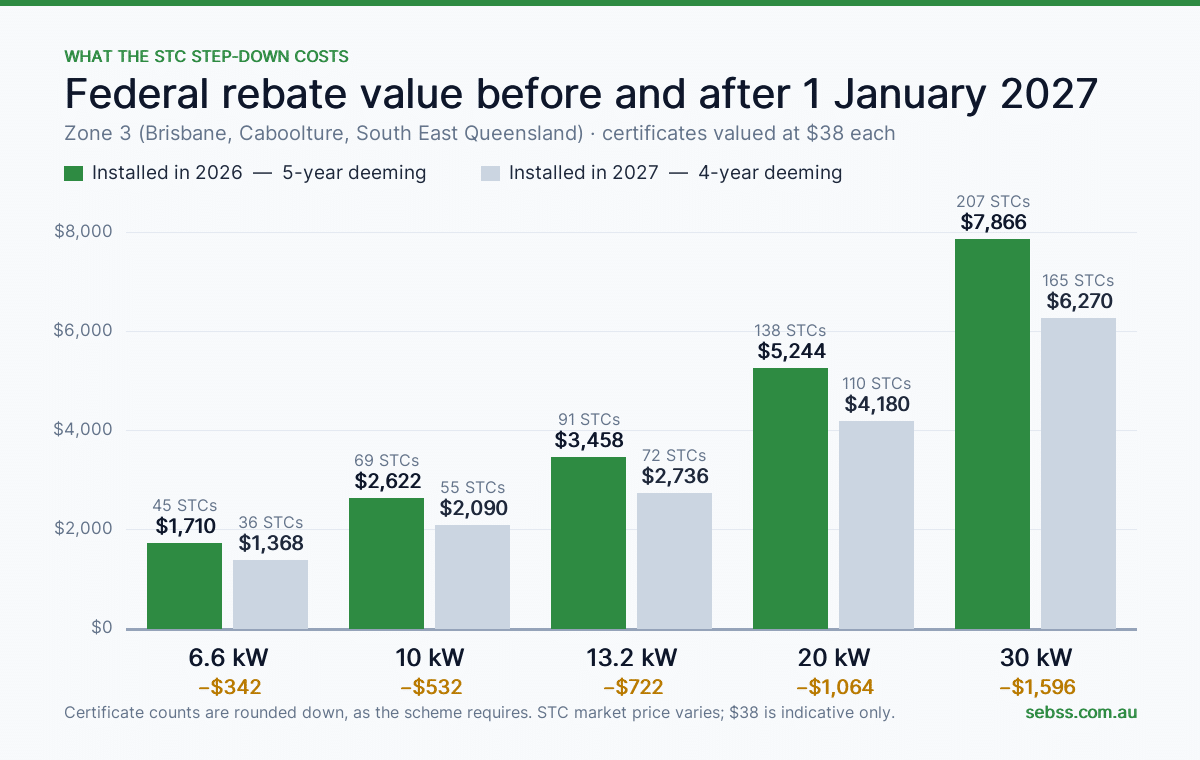
What the step-down costs, by system size
The percentage is fixed at 20%, so the dollar figure scales with the system. For a typical home the difference is a few hundred dollars. For a commercial array it runs into thousands.
| System | 2026 | 2027 | Difference |
|---|---|---|---|
| 6.6 kW | $1,710 | $1,368 | −$342 |
| 10 kW | $2,622 | $2,090 | −$532 |
| 13.2 kW | $3,458 | $2,736 | −$722 |
| 20 kW | $5,244 | $4,180 | −$1,064 |
| 30 kW | $7,866 | $6,270 | −$1,596 |
| 99 kW | $25,992 | $20,786 | −$5,206 |
The scheme covers systems up to 100 kW, so the largest exposure sits with commercial installations. A 99 kW array — the biggest that still qualifies — drops by around $5,200. If you are modelling a commercial payback, that is a real line item, and it belongs in the version of the spreadsheet you actually make the decision from.
Batteries step down on the same date
The Cheaper Home Batteries Program runs on the same certificate mechanism, and it steps down on 1 January 2027 as well — though on its own schedule.
Since 1 May 2026 the battery discount has been tiered by capacity rather than paid flat. The full rate applies to the first 14 kWh of usable capacity, a reduced rate from 14 to 28 kWh, and a much smaller rate from 28 to 50 kWh. Capacity beyond 50 kWh attracts nothing at all.
To qualify, the battery must be on the Clean Energy Council approved product list and be capable of joining a Virtual Power Plant — capable, not enrolled. You can decline to join one and still claim the discount. One system per property, claimable once.
We went through the battery side in more detail in Battery Rebates 2026: What Actually Changed, and the sizing question in How to Size a Home Battery Without Overpaying. If you are adding storage to an existing array, our battery storage page covers the retrofit path.
Queensland has no state rebate behind it
Worth being blunt about this, because a lot of pages online still imply otherwise. The Queensland Battery Booster program closed to new applications in 2024 and has not been replaced. There is currently no Queensland state rebate for new residential solar or battery installations.
Practically, that means the federal certificate scheme is the whole rebate. There is no second program to catch what the step-down takes away, and nothing worth waiting for.
What “installed in 2026” actually means
The deeming period is set by your installation date — not your deposit date, not your contract date, not your order date. A system paid for in November 2026 but commissioned in January 2027 is a 2027 system, deemed for four years.
That matters because December is the busiest month in the Australian solar calendar, every year, for exactly this reason. Installer availability, grid connection approvals and panel supply all tighten at once, and retailer approval alone can take several weeks.
So if the 2026 rate is worth having, the useful deadline is not 31 December. It is whenever your installer’s December schedule fills up — which is usually somewhere in October.
So should you rush?
No — but do not drift, either.
The step-down is a reason to put the decision on a timetable, not a reason to sign something you have not read. A system that is sized wrong, or built on whatever panels were in a warehouse in December, will cost you far more across 25 years than the rebate difference ever will.
The order that works: get the load profile right, size the system to it, choose the hardware, then let the calendar decide the install date. If that lands before the end of December, the extra year of deeming is a bonus on a decision you were making anyway. You can see how that plays out on real sites in our Queensland case studies, or start with residential solar if this is for a home.
What is not a good reason to wait: expecting the rebate to improve. Between now and 2030 it has one direction of travel, and it is down.
Frequently asked questions
The deeming period falls from five years to four, which cuts the certificates your system generates by 20%. For a 6.6 kW system in South East Queensland that is roughly $340. For a 30 kW commercial system it is closer to $1,600, and for a 99 kW array around $5,200.
No. It reduces in 2027 and keeps reducing every January after that. The Small-scale Renewable Energy Scheme ends in 2030, so 2030 installations are deemed for one year and there is nothing after that.
No. Your installer creates and assigns the certificates and applies the value as a discount on your invoice. You do not lodge anything with the Clean Energy Regulator yourself.
The installation date. A system commissioned on or before 31 December 2026 is deemed for five years regardless of when the deposit was paid, and a system commissioned in January 2027 is deemed for four even if it was ordered months earlier.
Yes. Australia is split into four solar zones. Most of South East Queensland, including Brisbane and Caboolture, sits in Zone 3 at a rating of 1.382. Parts of central and western Queensland fall into Zone 2 at 1.536, which generates more certificates for the same system size.
Yes. The Cheaper Home Batteries Program also steps down on 1 January 2027, on top of the capacity tiering that started in May 2026.
Lock in the 2026 deeming rate
We model your generation, size the system to your actual load profile, and return a fixed-price proposal with the certificate discount itemised — usually within 48 hours. December books out early; October is not too soon to start.